Add records from any Salesforce object to Campaign Monitor.
Map Salesforce fields to Campaign Monitor custom fields.
Schedule to automate the process.
Video Overview Below is a detailed video overview. You can skip to specific sections by hovering on the timeline or clicking on the play bar's chapter list.
Creating an Import Before you begin you will need a subscriber list and a data source (Salesforce campaign, report, list view or SOQL statement).
Go to the Subscriber list tab in Salesforce.
Then click the label of the list i.e. SL-0001.
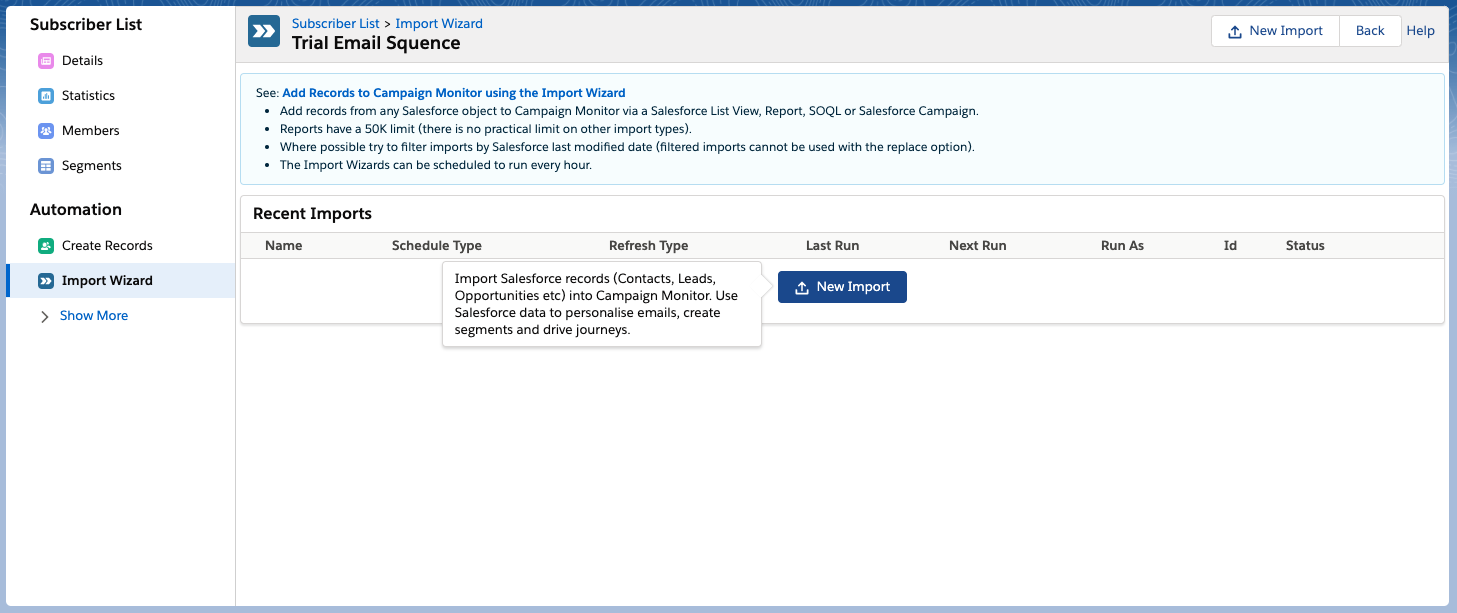
Now click Import wizard then click the new import button.
Select your data source and then click next.
Map Salesforce fields to Campaign Monitor.
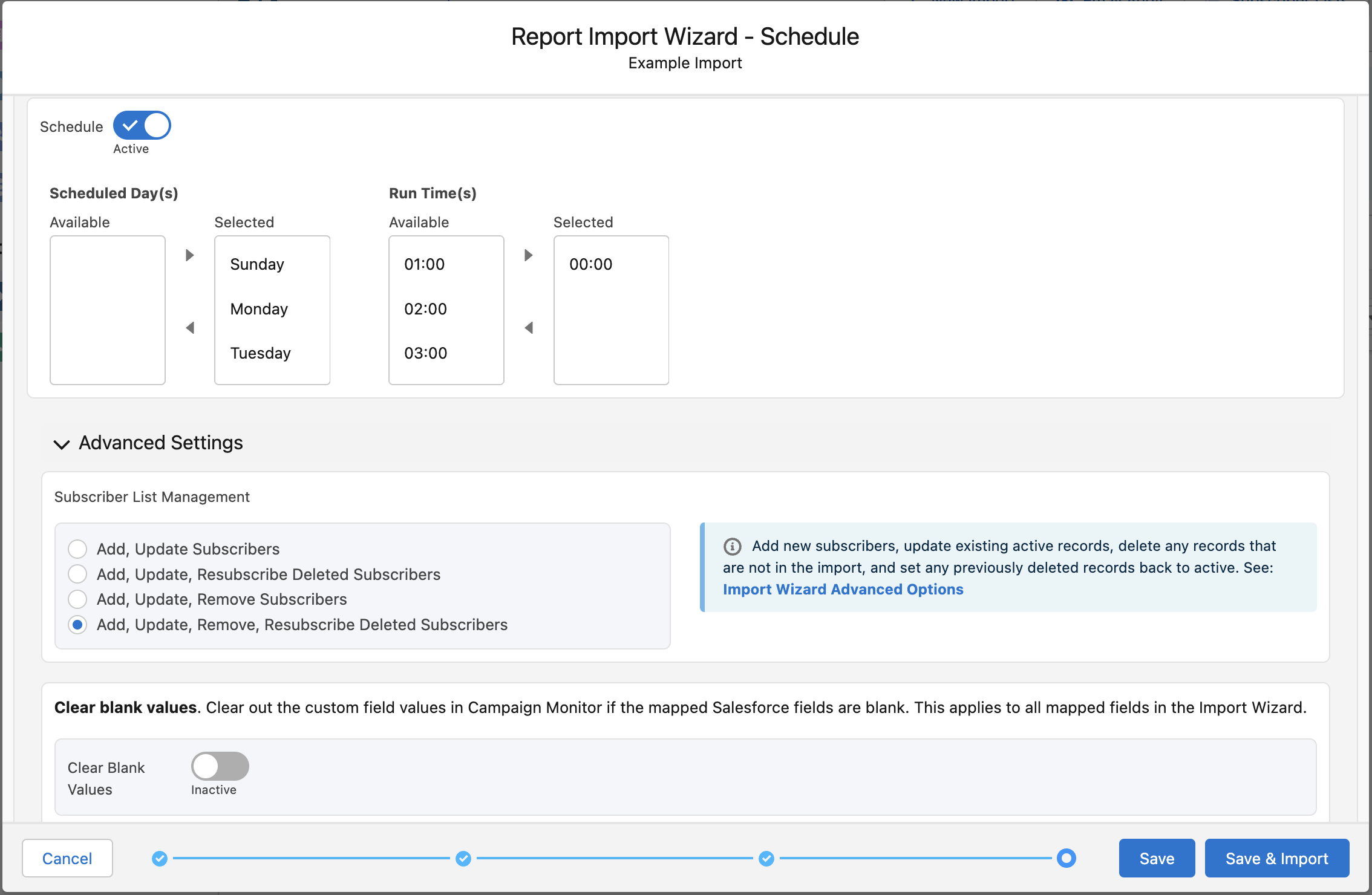
Immediately start the import, or set up a schedule for future runs or both .
Salesforce limits report imports to 50,000 records. If you are using Salesforce Professional list view import are not supported. If you set up the import wizard using a list view it will not update should the view be changed. To update an import using a list view edit and click through to save the changes.
Advanced Settings On the schedule page of the import wizard you will find a collapsed section for advanced features . For most customers these settings are not needed.
List Management (Refresh types) The Campaign Monitor import wizard allows you to add, update from your lists. You can also choose to resubscribe deleted subscribers.
Refresh types that only add subscribers:
Add, Update Subscribers ("Update", default) This is the default option. It will add or update subscribers that are in the source import. This is labeled as"Update" refresh type on Import Wizard lists for an audience.
Add, Update, Resubscribe Deleted Subscribers ("Resubscribe") In addition to adding and updating subscribers, this option will also set deleted subscribers back to active. Please Note - Bounced, unsubscribed, or suppressed subscribers will not be resubscribed. "Resubscribe" refresh type.
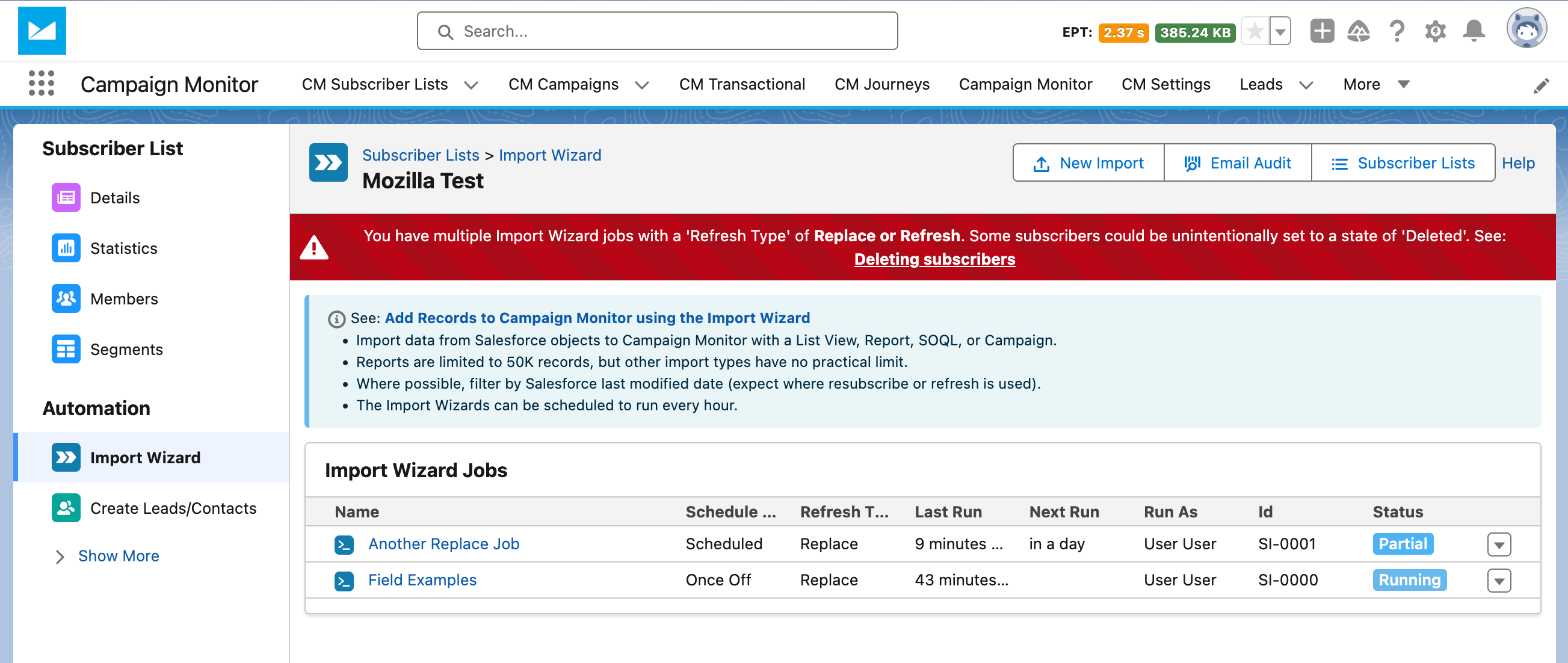
Important! If you have multiple import wizards on the same subscriber list, use the options below with caution. The remove feature deletes any subscriber not on the source. It ignores the source for other wizards.
Refresh Types That Can Remove Subscribers: Add, Update, Remove Subscribers ("Remove") In addition to adding and updating subscribers, this option will also set any subscribers in Campaign Monitor to deleted if they are not in the source import. Important - This will not resubscribe people who were previously deleted, bounced or unsubscribed. "Remove" refresh type. Add, Update, Remove, Resubscribe Deleted Subscribers ("Refresh") This option will complete all four actions. It will add and update records. If records are not in the source import they will be set to deleted in Campaign Monitor. Records in the import w a deleted status in Campaign Monitor will be made activ
Which option should you choose? The best option for you will depend on your specific needs. If you only need to add or update subscribers, then the default option is fine. If you need to resubscribe deleted subscribers, then you should choose Resubscribe. If you need to remove subscribers from your lists, then you should choose Remove. And if you need to do all four actions, then you should choose the Resubscribe.
Clear blank values If you have mapped a field to Campaign Monitor that has a blank value in Salesforce. And you want this to also set the value in Campaign Monitor to blank. You first need to enable the
clear blank value option .
Create segments This feature allows you to create and populate a
segment as part of the import wizard. This can be useful where you have a single subscriber list but would like to email only some of those subscribers using segment rules in Campaign Monitor.
Enable the feature: The setting is found on the CM Settings tab under General Settings, in the Import Wizard section. You can also
click here to locate the setting. This will expose a Segment Name field in the Advanced Settings.
Once the import completes:
1. A new Campaign Monitor custom field "Salesforce Segment" will be created (if not already present) and include your segment name.
2. A new Campaign Monitor segment rule will be created based on that name.
4. If the wizard had a different segment name set previously, the old value willl be overwritten. This will "move" members to the newer segment via the rule.
Note: Setting segments by the wizard is a complex feature. Please read the FAQs below to fully understand its use.
Expiration Date If you have scheduled an import wizard you can optionally put an expiry date in. This will stop the import from running again after the selected date.
You can permanently remove subscribers from a Campaign Monitor subscriber list. If these records are imported in any way either via our integration or directly they will be considered as new subscribers.
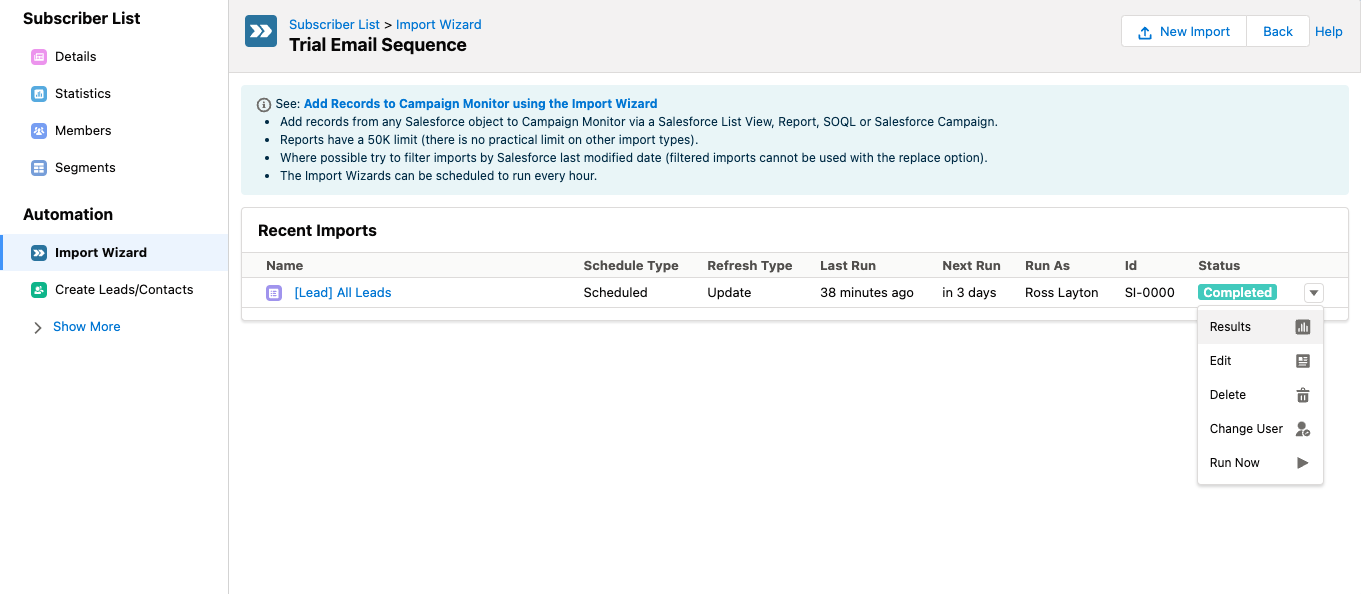
Managing an Import Once an import has been created, a record will show in the recent imports table. The record will show key information such as when it last ran, when it will next run, and who it runs as. In addition to the far right, there is a dropdown arrow. Once clicked, a sub-menu will show the following options:
Results - Shows the results of the last import.
Edit - Allows you to make changes to the import.
Delete - Will delete the import record, stopping any future runs.
Change user - Changes the running user of the import.
Run now - Runs the import immediately once clicked.
Global general Options There are also some global options that apply to the import wizard. If it is enabled it will apply to all imports. To review the option please
click here (CM Settings tab, under General Settings.)
Prevent Contacts or Leads being added to lists when Email Opt Out is checked (Import Wizard Only) With this option enabled if an email address belongs to a contact or lead record that has the standard email opt out field set to true they will not be added to Campaign Monitor. It is worth noting that if there are duplicate records and any of those records are opted out none will be added to Campaign Monitor.
Enable Import Wizard Segments This option needs to be enabled to show the segement option as part of the import wizard see above.
Scheduling Salesforce has a few hard limits which everyone has to respect. A good example of a Salesforce limit is the number of schedule Apex jobs you can have running at the same time. Each selected day and time on the import wizard scheduler page counts as a job.Subscriber Imports Report (Schedule) found in the Campaign Monitor for Salesforce report folder.
Next Steps Below are two articles that are recommended reading and the best next steps.
FAQs
Which Salesforce fields can I map in the import wizard? The fields available to map depend on the source you choose in the import wizard . To map a Salesforce field, it needs to be present in the source itself, not just somewhere on the object.
• Reports: Any field that's a column on the report. Add it as a column on the report, and it becomes available in the wizard.
• List Views: Any field that's a column on the list view. List views generally can't show relationship fields, like a field from a related Account, as columns. If you need one, add a formula field on the source object to pull the value in, then add that formula field as a column.
• SOQL: Any field in your SELECT statement. Unlike list views, SOQL allows relationship fields directly, for example Account.Name .
• Campaigns: Fields must exist on the Campaign Member object. Contact and Lead fields aren't included. Use a report on Campaigns and Campaign Members instead if you need that data.
Notes:
• Whatever source you choose, the Email field must be included, so the sync can match the record to a Campaign Monitor subscriber.
• If you change the source afterward, such as adding or removing columns or switching reports, list views, or objects, walk back through the wizard again so the mapping screen picks up the new fields.
• Store the reports and list views you use in import wizards in a folder with restricted sharing, to avoid someone accidentally updating a report unrelated to the wizard.
Related Articles
• Import Wizard [Full Guide]
• Why is a report missing from the Import Wizard's source picklist?
• How do I create a new Campaign Monitor custom field?
How do I create a new Campaign Monitor custom field? There are several ways to create custom fields in Campaign Monitor?
Import wizard: Note that the import source is what determines the fields available to map. The fields must be in the source as columns or fields.
First, confirm the Salesforce field you want to map is in your source (report or list column, SOQL statement or a Campaign Member field). We can only map those fields in the import. Click the Campaign Monitor Field pull-down menu and scroll to the bottom of the picklist. Screenshot: https://jmp.sh/sIvK5Kr5 Click New Campaign Monitor Field (Based on Salesforce field) . Click Next and run the import. When the import runs, we will create the new custom field for you, with the same field name and the correct data type.
Field mappings: You can also create a new Campaign Monitor custom field in the field mapping interface on each list.
Open the Subscriber List and click Field Mappings. Click Edit and then New Campaign Monitor Field. Choose the object from which you want to create a new field (contact, lead). Choose the field and and Click Select. We will add the new field to the Campaign Monitor field column and map it to the Salesforce field you chose. If you need to Edit the mapping direction, click the down arrow on the new row, the Edit Mapping to do that. Don't forget to save. When the import runs, we will create the new custom field for you, with the same field name and the correct data type.
In Campaign Monitor: You can create fields directly in Campaign Monitor as well. Be sure the data type matches.
Data types: All our mapping interfaces will only let you map fields with matching data types. Please see these guides on data types that require special handling:
Checkboxes , Picklists , Multiselect Picklists
How do I add Campaign Monitor custom fields? We have two places to add a new custom field to Campaign Monitor, without leaving the app. We will handle setting the data type, based on a Salesforce field.
Import Wizard:
Include the field you wish to map from in Salesforce as a column/field in your source report or list Start and step through the wizard to the Mapping step On the dropdown menu for the Salesforce field in question, scroll to the bottom and choose "New Campaign Monitor field (based on Salesforce field) Screenshot: https://jmp.sh/3ShsuiFh
Field Mappings:
Open field mapping for the list Click Edit Click New Campaign Monitor field. Choose the Salesforce object and field to base your new field on. Screenshot - https://jmp.sh/IdzOVRDz
Note: Campaign Monitor imposes a 40-50 field limit per Subscriber List. Customers are able to request an increase, however. Please contact Campaign Monitor support for more info. Once they increase your limit, our app can make new fields as needed with the options above.
More on field data types: Checkboxes , Picklists , Multiselect Picklists
How can I speed up large list imports? If you’re importing very large lists, the process can take some time. To improve performance, we recommend using a Last Modified Date filter Last 2 Days . This way, the filter adjusts automatically and only pulls in records that have changed recently.
Key tips:
First import:
Ongoing imports:
Single-object reports:
Small lists:
How do I stop a deleted field from being recreated? If you’ve used the wizard to create a field and later delete that field in Campaign Monitor, the wizard will automatically recreate it. To prevent this, you must edit the import wizard and update the “Map Fields” screen by setting the deleted field to “Nothing (skipped).
Does the import support a report that has summaries? The Import Wizard requires a Salesforce report that does not
How do I sync URLs to Campaign Monitor In Salesforce, you can build hyperlink formulas that create clickable links in Salesforce. These are encoded to display your label text and work within Salesforce UX. Therefore, you can't use these formulas to populate custom contact fields in Emma. When merged into emails, the link won't display correctly. Instead, you can either:
Create a text formula that constructs the URL just as a text string, see below Build the formula in the email editor using text from synced custom fields. Creating the right formula: Build your mapped formula field to return the URL's HTML. Don't use the HYPERLINK function. Formula example- use the URL in the link-builder in the Campaign Monitor email editor: https://jumpshare.com/embed/N1D3b7SwDW04mPgdcd3j Returned data to include in your import mapping: https://jumpshare.com/embed/enMRjd5xZFcSgkalC9d2 How to use the formula in the Campaign Monitor campaign builder:
In your List in Campaign Monitor, copy the merge tag for the contact field that holds the mapped formula. Use the shortcut name as the URL in the link component. Formula example - for merging the URL directly into the email A second option is to build an HTML statement with a Salesforce formula (text). You returned text, mapped to a custom contact field and then merged into the email body would look like this: Click here
Building the formula in the email editor
<a href="https://www.yourwebsite.com/login.php?user=[id,fallback=]">Login to your account</a>
Why is a report missing from the Import Wizard's source picklist? When you configure an import wizard to use reports, you can choose the folder where your report is stored. We will show a picklist of reports we can use. If your report is in matrix or joined format, it will not appear in the list. Grouped reports also can cause problems with the import. Please set the report to tabular before using it in an import.
More on import wizard limitations .
Does the import wizard have any limits? The import wizard is the best way to add and update records in Campaign Monitor.
The wizard makes error handling easy. We display the run's status as a badge (completed, scheduled, failed, etc.). Click the action menu next to the badge to View the Results . If you are an app admin, you can also check the maintenance logs .
There are some limitations to the import wizard worth noting:
Record Limit: If you are using a Salesforce report, then you will be limited to 50,000 records. This is the same limit you will run into if you attempt to add more than 50,000 records to a Salesforce campaign. In practice, this limit can generally be easily worked around.
Consider adding more filters to reduce the records in the report. For example, if you are scheduling the import then it is likely that records will not have changed since the previous import. You could filter your report to only include recently modified records. Making reports as efficient as possible also helps when the import wizard runs. Use the tabular format and only include the columns you need to map. Do not include groupings or totals. For your initial import, directly import the report (as a csv) into Campaign Monitor (i.e., outside of Salesforce). After that initial import via CSV, you can filter your Salesforce report only to include records modified in the last 24 hours. Use that report as your ongoing import source. Corrupted reports: Salesforce reports can become corrupted, though it is rare. This is not easy to spot within Salesforce. If the notes above do not solve an issue with an import not working, then consider creating a new source report from scratch.
Using other import sources:
If your import is quite basic, you need fewer than 15 fields mapped, and you are not using Salesforce Professional Edition ), you can use a list view. Or if you can write SOQL statements, you can use this as an import source. Missing members after an import? Visit our troubleshooting guide
Learn more about the Campaign Monitor for Salesforce Import Wizard .
Our integration can push data back and forth between Campaign Monitor and Salesforce. The installation and initial connection process limit the sync so that you can be selective in what you set up and importantly gives you total control on data movement.Campaign Monitor to Salesforce
Campaign Monitor Account Campaign Monitor Subscriber lists Campaign Monitor Subscriber list members Campaign Monitor Subscriber list members status changes i.e bounces or unsubscribes. Campaign Monitor Email tracking history
It is worth noting the data we push from Campaign Monitor to Salesforce is stored in custom objects within your Salesforce Org. So when you connect we are simply pushing a copy of your data from Campaign Monitor to Salesforce and then storing that in your custom objects. The point is the process and your data is very ring-fenced. Campaign Monitor subscriber list membership and email tracking history records will be linked to a matching Salesforce contact or lead if a match can be found.
General Settings information Optionally we can update or create Salesforce contacts or leads based on incoming Campaign Monitor data. To learn more please
click here .
Salesforce to Campaign Monitor If you want data to flow from Salesforce to Campaign Monitor you would then set up something like our
import wizard. The import wizard can add Salesforce records from a source like a report or a list view to Campaign Monitor. It can also update custom field values if mapped. Again the key point here is that for data to flow from Salesforce to Campaign Monitor, you first need to set up an import.
Why does an import schedule sometimes take longer? We have a process which runs every hour. On that hour, it picks up the total number of import wizard jobs that should be started and runs them in parallel. It prioritises jobs, putting jobs that recently ran last. Typically, for most customers, the imports all run, and the schedule will start again in the next hour.
What happens when multiple imports with segments are running? If you have more than one import wizard with our automatica segment option enabled, they might run simultaneously and conflict.
To mitigate this, the system checks if another segment-setting import job is already running on the same subscriber list before starting another import job with segments. If another job is found, the new job will wait until the current one finishes, "round-robin" style This prevents any conflicts or data issues. The held import job will start when the schedule next runs. We mark the import as Holding until then.
From a technical perspective, if you have a lot of imports on the same list using the segment option, a job that is delayed will get priority the next time the schedule runs. N.B. With >2 imports, this means a single import might be delayed over multiple hours until the entire list is able to be processed, one per hour).Staggered scheduling: If you have multiple imports on the same lists using the segment feature, a good option is to space the schedule apart yourself, one per hour. You can choose a custom schedule in the wizard, on the last page.
Alternative segmentation: If you prefer, you can avoid the above by not using the segment setting in the import wizard at all (disable its access by staff in CM Settings as well). Instead, map the Salesforce fields that define the segment to your Campaign Monitor custom fields. Then set up the segmentation rules in Campaign Monitor with those custom fields. This is especially useful if you use a static field on a Salesforce record (contact, lead, etc) that opts someone in or out of the segment.
Campaign Monitor Segmentation info
What happens if I change a segment name on an existing import? The import wizard in Campaign Monitor offers an optional feature to create a segment and add imported records to a selected subscriber list. If you edit the import and change the segment name, the wizard will automatically move the subscribers from the old segment to the new one.
How are Salesforce Campaigns sorted when importing via the import wizard? When you begin importing data into Campaign Monitor via the import wizard, you'll be prompted to select a Salesforce Campaign. To help you find the most relevant campaigns quickly, they are sorted by their 'Last Modified Date,' placing newer or recently modified campaigns at the top of the list. For performance and usability, only the first 500 campaigns are displayed.
How do I change the running user of an import wizard job? If you need to change who an import wizard job runs as follow the steps below:
Can I create custom field when using SOQL? We cannot create custom fields in Campaign Monitor via the import wizard if you use SOQL as a data source. This action is supported when working with reports or list views. If you need to work with SOQL instead, custom fields will need to be created directly in Campaign Monitor before you use the wizard.
Do you update subscriber members who are on the suppression list? We will never update a record that is on the suppression list even though it could be active. This is because Campaign Monitor blocks updates to a record that is on the suppression list. A record would need to be removed from the suppression list before it could be updated.
How do schedule jobs work? When a Salesforce user creates a scheduled import wizard, we set up a Scheduled Job, a standard Salesforce feature. We will only create one scheduled job per Salesforce user regardless of how many scheduled imports that user creates or is the Run As user for.
Why can I not see an object when working with the import wizard and list views? When you are using the import wizard you can select to work with list views. Once selected a pick list will show all the objects available to use. There are a few reasons an object might not appear in the pick list:
The user does not have permission to see it. The object is not associated with a navigation tab. The navigation tab has not been added to a Salesforce App. The object is not SOQL compatible. List views are very efficient and unlike Salesforce reports don't have a limitation on the number of records you can work with.
Does user timezone impact the import wizard schedule? When you set up our import wizard you have the option to schedule it for future runs. The schedule allows you to pick days and preferred start times. When a time is selected we use the timezone set on your user record. So if you schedule the import to run at 1 am the schedule will run at 1 am using the timezone set on your user record.
Can I use a list view with the import wizard on professional edition? Salesforce has various editions of its product. Unfortunately, this does lead to some limitations. The professional edition's lack of full API access means that you cannot use a list view with the import wizard. Instead, the best alternative would be to use a Salesforce report. Similarly, if you are using a base or essential edition you will see more limitations, technical Campaign Monitor for Salesforce only works with professional edition and above.
What happens if the import wizard does not run? The import wizard is very robust but it is possible for it to run into a problem. If that should happen we will attempt to log the error in three spots:
The import wizard schedule itself has a status for example completed or running. If there is an error it might be shown here. Salesforce standard notification which appears as a bell in the top right-hand corner of Salesforce Lightning Full access users can view maintenance logs .
Some Salesforce problems, which are rare, cannot be captured and logged but for the most part, if there is a problem it should be shown in one if not all three of the areas above.
Can I automatically create a segment? (Import Wizard segments) The import wizard can automatically create a segment. A typical use case is to create a segment in Campaign Monitor based on the name of a Salesforce campaign. Please follow the steps below:Enable Import Wizard Segments is enabled on the CM Settings tab, under General Settings. last step , which includes the schedule, click Advanced and enable Create Segment.
The name will be automatically generated, but you can change this.
IMPORTANT: On the import wizard mapping step, do not map anything to the system field called Salesforce Segment.When the import runs:
A new custom field will be created in Campaign Monitor called Salesforce Segment, if needed. The field is a multi-select picklist. so it can be used more than once; we will add new segment values from import wizards to it. The records contained in the import wizard will have the segment name populated against their membership records in Campaign Monitor. A segment rulewill be created in Campaign Monitor using the Salesforce Segment field and looking for the value in your import. Shortly, you will see those import members in two places:The list segment in Campaign Monitor The segment component in the Salesforce Subscriber list. Taking members off a segment:
If an email is no longer included in the source list when the import wizard runs, that email will be removed from segment in Campaign Monitor. This happens in delete job that runs immediately after the import finishes.
Changing segment names:
If you change the existing segment value on the last page of an import wizard and run it, this will move the import members to the new segment. It does this by overwriting what is currently stored in segments. The old segment will remain with 0 members until your delete the import wizard.
Creating segments on multiple wizards:
Multiple import wizards can be used to create different segments. However, this is complex and requires planning. Please see Creating segments across more than one import wizard.
Note : Depending on the import size, it can take a short time (typically less than 30 minutes) for the segment to show all records.
More info:
How do I clear picklist values in Campaign Monitor? If you have mapped a Salesforce picklist or multi-select picklist field the selected value(s) will be updated on the corresponding Campaign Monitor field.Clear blank values.
How can I import multiple reports into the same susbcriber list? You can create multiple import wizard imports on the same subscriber list. So for example, if you want to import two different Salesforce reports into the same subscriber list you can just create two different import wizard imports. There is no limit on the amount of import wizard imports you can create.
Points to note
You can create more than one import wizard import. Scheduled imports will use Salesforce resources and there are limits on the number of scheduled jobs you can have. It is always a good idea to make the source i.e. a list view, report, etc. as efficient as possible. This could be achieved when updating records to limit to only recently modified records. The replace feature should only be used on a subscriber list that has one import, otherwise another import would compete during the replace process
How can I work with more than one email address for the same person? In Campaign Monitor, an email address can only be on a subscriber list once. The subscriber list membership records are contained within a flat table. So there is no possibility to link records or have a single subscriber with many different email addresses.
Create two Salesforce reports containing the fields you need. Be sure to include the Salesforce contact Id and one of the email addresses (e.g., a personal email on one report and a work email on the other). Use our import wizard to create an import schedule for the first report. Then create another import using the wizard for the second report. On both wizards, map the contact Id to the Salesforce ID field in Campaign Monitor. More on mapping Salesforce ID (override email matching) . Using separate imports with different reports will allow you to work with multiple email addresses. We will use the contact or lead ID (instead of just one email) to match Campaign Monitor records when synching data back to Salesforce. Subscriber list membership and email tracking records will be linked to the same contact or lead.
Why are records missing from my import? The import wizard typically adds records using a report or list view, so you might see a difference in the number of records added versus what is added to Campaign Monitor.
Below is a list of possible issues:
The email address is empty The email address is invalid The email address is duplicated within the source The email address already exists in Campaign Monitor The email address is on a Campaign Monitor suppression list The email opt-out field is checked (depending on your settings) There is a picklist value in Campaign Monitor that does match the Salesforce value (they need to match exactly) Import Results : You can check the import results for errors or messages about missing emails.
If you do find a record that should be added and does not meet the criteria above,
Go to the Salesforce subscriber list record Choose Members Click the Email Audit button and add the email address to see why it is not going across. This should give you immediate feedback on why the specific record could not be added.
Another way to troubleshoot is to try to add the member via our Subscriber Memberships component
Why are records missing from my Campaign Monitor segments? Updating data in Campaign Monitor is quite complex and there are few ways to do it.
Segments are based upon custom fields contained in your Campaign Monitor subscriber lists. A subscriber record in Campaign Monitor will need to have a value that matches the segment criteria to be in the segment.
If records are missing from your segment there are a few easy checks you can do in the order below:Campaign Monitor
If the custom field in Campaign Monitor is a picklist ensure the values are exactly the same as those in Salesforce. Find a subscriber that should be in the segment but is not. Check the subscriber to see if they are active on the list, records that are not active will not be updated. Does the subscriber have the correct values (per the segment rules) to be part of the segment, if they are correct the problem is with the segment rule itself? Duplicates
If you are happy the points above are correct and the problem lies in Salesforce please copy the email address.
Paste the email address into the Salesforce global search. If you find duplicate records with the same email address, this could be a problem. If you have only one record check to see if the data in the segment field is correct in Salesforce and matches what's on the subscriber. Import/data check- Import Wizard
Again if you are happy with the points above the next step is to check the subscriber list itself in Salesforce.There are two ways our integration can update a custom field in Campaign Monitor. The import wizard of field mappings.:Import WizardThe import wizard requires a source e.g. a list view, report, campaign, or SOQl query. Check to make sure that:
The record you are looking for is included in the source. The field you are segmenting upon is included in the source. On the import wizard mapping screen, the field is mapped. The import has run recently and successfully. Data check- Field Mappings
If a person is active on a subscriber list that has field mappings setup (SF>CM) when the Salesforce record is edited it will fire a trigger to update Campaign Monitor. Check to see that:
Field mappings have been set up on the subscriber list The field the segment is based upon is mapped in the direction of Campaign Monitor to Salesforce
While on the field mappings click the Retrospective Sync button. This will kick off a process to update all records that are active in the subscriber list. Once the process has run check to see if the record has been updated in Campaign Monitor. Go to the person contact or lead record in Salesforce and click edit, without making changes click save. This will fire our trigger and attempt to update the data in Campaign Monitor. If the record has been updated this points to a problem with the trigger most likely permissions or a conflict with other automation or validation.
Check the Maintenance Logs . If we can catch an error, we will record it here usually.
Safety net:
Create a Salesforce report that contains the fields you are using in-field mappings. Filter that reports so that it only includes records that were last modified today. When you set up the scheduling of the import wizard choose to have, it runs every hour of every day.
Getting more help:
The email address you have been working with. The field is not updating. The name of the subscriber list. The name of the segment. Grant Login Access (steps below) Grant Login Access
Why does the import wizard not run for a specific user? Like a lot of Salesforce, the import wizard is governed by permissions. So if it fails to run under a specific user, the problem is typically permissions. Below are some checks we recommend going through:
Does the user have our standard or full permission sets? If you are not sure, please review this support article . If the source is a Salesforce report, can the user run the report and see all the fields? If the source is a list view, does the user have access to it and all the fields? When the import fails, is there any message logged in maintenance ? If the above options don't help please contact us.
How does personalisation work? Personalisation happens within Campaign Monitor via custom fields. Our integration allows you to map Salesforce data to Campaign Monitor custom fields. Most customers use our import wizard in-built field mapping feature to add subscribers and map to custom fields.
If you use one of our other features to add Salesforce Contacts or Leads to Campaign Monitor, you can use the field mapping feature. Once the data is added to Campaign Monitor, you can use custom fields to personalise your emails. This article from our friends at Campaign Monitor shows how.
How do I create segments based on Salesforce field data? Segment rules group subscribers together based on criteria like Last Gift Date or Total Sales. Such segments can therefore be based on custom fields in your Campaign Monitor subscriber lists that are populated by Salesforce data.
1. Identify the custom fields you need in Campaign Monitor to drive the segment rules. 2. Create and map custom fields:
If you need to create new fields in Campaign Monitor, our import wizard and field mapping features allow you to quickly and easily create and map them to Salesforce fields.
Remember: You can build an import wizard from any object, so you can segment off of data that isn't on contacts or leads. Your import source just needs an email field.
3. Build segment rules:
To do this, log in to Campaign Monitor directly or click the Campaign Monitor tab in Salesforce.
Then follow this segmentation guide from Campaign Monitor .
4. Segment with the integration:
When the wizard runs or field mappings are triggered, your data will be synced to the new mapped fields.
If the values in those fields match the segmentation rules, the subscriber will be included in the segment.
Segments are dynamic, so the data is up to date as of the most recent sync from Salesforce.
More info:
What is re-subscribing and how does it work via the import wizard? If a person has unsubscribed or been deleted they are no longer active. Re-subscribing is the process of making a person active again.
Deleted
The import wizard by default will only add records. However, you can enable a setting to re-subscribe deleted subscribers.General settings tab
Unsubscribed
Subscriber Rules and our invocable actions are the best options for resubscribing. The import wizard has a hidden option which can be enabled at the import level. It is a bulk action so needs to be used with extreme caution. If you have questions please contact us.
How can I change the running user of an import? To change the running user:
On the import wizard page click on the dropdown next to the import. Then click change user, this will open up a confirmation screen. Once changed the import will run under the user making the change.
Are there any reasons the replace feature will not work? The replace option only works on stored Salesforce data. So if you have disabled our triggers or have chosen 'Don't sync members of this list to Salesforce,' the replace will not work. It is worth noting that it is rare to have either in place. A more likely reason is that the primary sync has failed, and therefore data in Salesforce is not up to date. Again this is rare but worth checking.
How can I stop duplicates? Campaign Monitor does not allow the same email address to appear on a list more than once. If you are using the import wizard to add records and the source contains duplicates records, only one email address will be added to Campaign Monitor.
Can I see the results of an import? Yes, every time an import runs we store the results to show what updates occurred in Campaign Monitor.
Select the subscriber list you want to work with by going to the Subscriber list tab . Then click the Label of the list i.e. SL-0001. Now click Import wizard. Click on the Dropdown arrow on the far right of the import you wish to View . Click Results .
Can the import wizard run outside of the schedule? The import wizard can be run manually or via a schedule, however for Enterprise users you can run an import wizard job via a Process builder invokable action.Subscriber rules ).
Why use the Import wizard vs Subscriber rules? Below is a table of key differences between the import wizard and subscriber rules. We recommend using the import wizard when possible.
Import wizard Works with any Salesforce object or combination of objects. You can import any email field. Includes field mappings for all included fields. Can run every hour of every day. Runs as a specified user, making tight security and sharing easier. Avoids conflicts with your other automations on contact or leads by running in batches. Subscriber rules Only works with contacts and leads. Limited to the standard email field. Can be combined with field mappings (no separate mapping per rule). Runs as user who triggered the rule, so you must ensure they have the proper object and record access, as well as our permission set. Triggers instantly, so you must consider how it will interact with other automation.
How to update picklist values in Campaign Monitor? Both Salesforce and Campaign Monitor can have picklist field types. The values contained within these fields can change. If a value changes in Campaign Monitor then this will need to be manually updated in Salesforce to match exactly. Our integration can update Campaign Monitor pick list fields if the values are mapped and active as part of the import wizard.
What happens if my import contains duplicate email addresses? An email can only exist once in a Campaign Monitor list. If the source you are using with the import wizard contains the same email on more than one row, they will not be duplicated in Campaign Monitor. A Campaign Monitor subscriber list stops duplicate emails being added during the import.
We will add the first line in the import we come to with that email, including all its mapped fields, and then skip the next encountered. We can't control the order of source rows on insert, either.
This means you may be sending the wrong contact's mapped field data over if you have duplicate emails in the report. This can be a problem for merging email content, but especially for segmentation using mapped field data.
Ensure your report includes only one instance of the email in all the rows to avoid this. You can also map Salesforce record IDs to override simple email matching, but your source report for setting those IDs must, again, only include the needed contact and not any of the dupes.
See more on overriding email matching
How do I update the import wizard when I change the associated list view? To update the changes to a list view in the import wizard you simply need to edit the import and click next to page through, finally click save or save and import.
I can't add a new Campaign Monitor field when using SOQL The import wizard allows you to create and map Campaign Monitor fields except when using SOQL as a data source. The only option is to create the field in Campaign Monitor first. You can do this directly in Campaign Monitor or via the Campaign Monitor tab in Salesforce.

 CAMPAIGN MONITOR FOR SALESFORCE · GUIDE